





Odoo for Ecommerce
One Platform to Run Your Entire Online Business
From storefront to warehouse to accounting, Odoo gives ecommerce brands a fully integrated system to manage sales, inventory, payments, and customer relationships — without juggling disconnected apps.
Trusted By
Benefits
Why Ecommerce Brands Choose Odoo
Running an online store means managing far more than just a website. Your inventory lives in one system, your orders come through your store, your accounting sits somewhere else, and your customer data is fragmented across tools. Odoo brings everything together in one platform designed for how ecommerce actually works.
- Real-time inventory sync: Stock levels update across all sales channels instantly, eliminating overselling and stockouts
- Unified order management: Every order from your website, Amazon, or marketplace flows into one centralized pipeline
- Built-in website builder: Drag-and-drop ecommerce site designer with SEO tools, product pages, and promotions
- B2B and B2C in one system: Run wholesale portals with customer-specific pricing alongside your public store
- Seamless accounting integration: Sales automatically create invoices, track revenue, and reconcile payments
- Multi-channel selling: Connect Amazon, eBay, Shopify, WooCommerce, and more from a single backend
- CRM and marketing automation: Track customer behavior, run email campaigns, and recover abandoned carts
-
No integration debt: Every Odoo app speaks the same database, so data never gets stuck
in silos
Problem Solving
Ecommerce Solutions We Build with Odoo
We’ve helped ecommerce brands transition from fragmented stacks to unified Odoo systems. Here’s where we focus our implementation work.
Odoo Ecommerce Website
Build a fully functional online store with Odoo's native website builder. We configure product catalogs, payment gateways and checkout flows that match your brand.
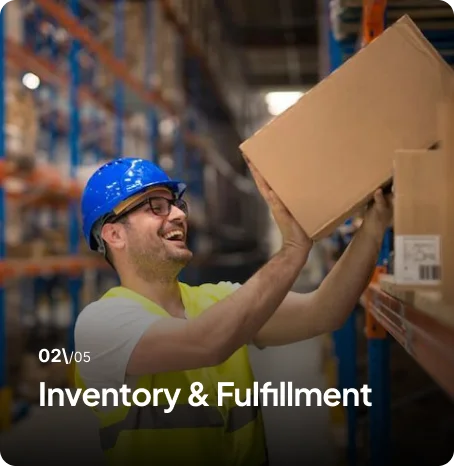
Inventory & Order Management
Set up multi-warehouse inventory with real-time stock tracking, automated reordering rules, and barcode integration.
Multi-Channel Integration
Connect your Odoo backend to Amazon, eBay, Shopify, WooCommerce,other market places. Centralize product listings, manage orders from dashboard.
B2B Ecommerce Portals
Create password-protected wholesale portals with customer-specific price lists, minimum order quantities, quote requests, and custom payment terms.
Payment & Shipping Automation
Configure Stripe, PayPal, Authorize.net, and other payment providers. Automate shipping label generation with DHL, FedEx, and UPS integrations.
Marketing & Customer Retention
Deploy email marketing campaigns, abandoned cart recovery, promotional codes, and loyalty programs directly from Odoo.
Business Management
How Odoo Manages Your Ecommerce
Business End-to-End
Most ecommerce businesses stitch together a website builder, a separate inventory system, an accounting tool, a CRM, and various marketplace connectors. Odoo replaces all of that with one cohesive platform.
- AI-assisted website builder with drag-and-drop product page creation
- Custom themes, product variants, and attribute filters
- Built-in SEO tools: meta tags, URL slugs, sitemaps, canonical tags
- Multi-language and multi-currency support
- Abandoned cart tracking and recovery emails
- Customer portal for order history and returns
- Real-time stock tracking across multiple warehouses and locations
- Automated reorder points and supplier replenishment
- Barcode scanning for receiving, picking, and shipping
- Landed cost tracking for imported products
- Batch and serial number tracking
- Dropshipping and cross-dock workflows
- All orders from website, marketplaces, and POS in one pipeline
- Automated order confirmation, invoicing, and fulfillment status
- Return management with automatic inventory and accounting updates
- Subscription and recurring order support
- B2B quote-to-order workflows
- Automatic invoice generation from every sale
- Payment reconciliation with Stripe, PayPal, and other gateways
- Tax automation with region-specific rules
- Profit margin analysis by product, category, and channel
- Multi-company and multi-currency support
- Real-time financial reporting and dashboards
- Unified customer database with full purchase history
- Segmented email marketing campaigns
- Automated follow-ups and lead nurturing
- Live chat and helpdesk for customer support
- Social media integration for product promotion
- Google Analytics and conversion tracking built in
Our Expertise
Ecommerce Challenges Odoo Solves
Ecommerce brands face operational problems that standalone website platforms can’t fix. Odoo addresses these gaps head-on.
"Our inventory is always wrong"

Manual sync between your store and warehouse leads to overselling, stockouts, and angry customers. Odoo updates stock levels in real time across all channels, so what’s shown online is what’s actually available.
"We're spending too much on apps and integrations"

Shopify store + accounting software + CRM + inventory tool + marketplace connectors = dozens of monthly subscriptions. Odoo consolidates everything into one platform at a fraction of the combined cost.
"Order fulfillment takes too long"
Orders get emailed, re-entered into a separate system, and tracked on spreadsheets. Odoo automates the entire flow: order received → invoice generated → inventory allocated → shipping label created — all without manual data entry.
"We can't sell B2B and B2C from the same system"

Managing wholesale pricing, quotes, and net terms requires a separate platform. Odoo runs both storefronts from one product catalog and one backend, with role-based access and customer-specific pricelists.
"Financial reporting is a nightmare"
Reconciling sales from multiple channels against bank deposits and fees takes hours. Odoo links every transaction to your accounting, so revenue, costs, and profitability are always up to date.
"Scaling means more systems, not fewer"

Adding a new sales channel or warehouse usually means another integration project. Odoo’s modular architecture lets you add channels, locations, and features without rebuilding your tech stack.
Official Odoo Silver Partner helping Ecommerce Management.
Our Approach
Why Businesses Work With OneStopOdoo
Ecommerce is just one part of your business. These Odoo modules integrate natively with your online store to give you a complete operational system.

Launching Your Store
- Set up your first Odoo ecommerce website in days
- Connect payment processing and basic shipping
- Manage your initial product catalog and inventory
- Track sales and expenses from day one
- No need to migrate later — start with the right foundation

Scaling Operations
- Add multi-warehouse inventory management
- Connect Amazon, eBay, or other marketplaces
- Automate email marketing and cart recovery
- Implement B2B pricing and wholesale portals
- Streamline fulfillment with barcode and batch processing

Multi-Brand / Enterprise
- Run multiple storefronts from one Odoo instance
- Centralized reporting across brands and channels
- Advanced manufacturing and assembly workflows
- Custom API integrations for EDI and 3PL connections
- Multi-company consolidation for group-level reporting
Implementing Odoo for ecommerce isn’t just about installing modules — it’s about designing workflows that fit how your business actually operates. Here’s why brands trust us.
Why OneStopOdoo for Ecommerce Implementation
We hold Odoo Silver Partner status, giving us direct access to Odoo's technical resources, certification programs, and early feature previews. Our team stays current with every Odoo release.
We don't treat ecommerce as an afterthought. Our implementation process starts with understanding your sales channels, fulfillment model, and customer journey — then builds the Odoo configuration around that.

From initial discovery to go-live and beyond, we own the project. That means data migration, module configuration, third-party connector setup, staff training, and post-launch support — all handled by our team.

Marketplace connectors, payment gateways, shipping providers, and 3PL integrations are where most ecommerce implementations fail. We've built and deployed these integrations across dozens of client projects.

Certifications


Services
Related Odoo Services for Ecommerce Brands
Ecommerce is just one part of your business. These Odoo modules integrate natively with your online store to give you a complete operational system.

Odoo Accounting
Automated invoicing, payment reconciliation, tax compliance, and financial reporting

Odoo Inventory
Multi-warehouse stock management with barcode scanning, automated reordering, and real-time visibility

Odoo CRM
Centralize customer data, track purchase history, and automate follow-ups from leads to repeat buyers

Odoo Manufacturing
Track production, manage bills of materials, and synchronize finished goods with inventory

Odoo POS
Connect your physical retail locations to the same inventory and customer database as your online store

Odoo Marketing
Email campaigns, social media posting, SEO tools, and conversion tracking

Odoo Helpdesk
Handle customer support tickets, returns, and warranty claims in one system

Odoo Purchase
Automate supplier orders, track landed costs, and manage procurement workflows
Testimonials
Hear from our Clients

Moving from Shopify to Odoo was the best decision we made. We cut platform costs in half, gained full control over our store design, and the team was amazing to work with. The custom features they built gave us an edge over competitors.

Olivia Bennett
Fashion Brand ($1.2M revenue) | Founder

Moving from Shopify to Odoo was the best decision we made. We cut platform costs in half, gained full control over our store design, and the team was amazing to work with. The custom features they built gave us an edge over competitors.
James Harrington
Retail Chain ($3.5M revenue) | Operations Director
Frequently asked
question
Can Odoo replace Shopify or WooCommerce?
Yes. Odoo’s native website builder includes a full ecommerce module with product catalogs, payment processing, shipping integrations, and checkout flows. Many brands migrate from Shopify or WooCommerce to Odoo to eliminate the need for separate backend systems. You also have the option to keep your existing storefront and connect it to Odoo for backend operations.
How does Odoo handle multi-channel selling?
Odoo can connect to Amazon, eBay, Shopify, WooCommerce, and other marketplaces through native connectors or third-party integration modules. Product listings, inventory levels, and orders sync between Odoo and each channel, so you manage everything from one dashboard. Stock updates happen in real time to prevent overselling.
Can Odoo support both B2B and B2C stores?
Absolutely. Odoo allows you to run a public B2C storefront and a password-protected B2B portal from the same product catalog. B2B customers can access customer-specific pricing, submit quote requests, order on net terms, and view their account history — all while sharing the same inventory and order management backend.
What payment and shipping providers does Odoo support?
Odoo integrates with major payment providers including Stripe, PayPal, Authorize.net, and many regional gateways. For shipping, it connects with DHL, FedEx, UPS, USPS, and other carriers to automate rate calculation, label generation, and tracking. Additional providers are available through the Odoo Apps marketplace.
How does Odoo handle inventory across multiple warehouses?
Odoo tracks stock levels by location, so you can manage inventory across multiple warehouses, stores, or fulfillment centers. You can set up automated replenishment rules, transfer orders between locations, and configure which warehouse fulfills orders from each sales channel. Barcode scanning streamlines receiving, picking, and shipping operations.
Is Odoo's website builder SEO-friendly?
Yes. Odoo includes built-in SEO tools for editing meta titles, descriptions, URL slugs, and canonical tags. It automatically generates sitemaps, supports structured data, and integrates with Google Analytics. The page builder also allows you to control heading structure, image alt text, and page speed optimization.
How long does an Odoo ecommerce implementation take?
A basic Odoo ecommerce setup can go live in 4-8 weeks, depending on the complexity of your product catalog, number of sales channels, and custom requirements. Multi-channel integrations, B2B portal configuration, and data migration from existing systems may extend the timeline. We provide a detailed project plan during the discovery phase.
Can I migrate from Shopify or WooCommerce to Odoo?
Yes. We handle data migration from Shopify, WooCommerce, and other platforms, including product catalogs, customer records, and historical order data. The migration approach depends on your data volume and structure, and we map everything to the appropriate Odoo models before go-live.
Does Odoo support subscription or recurring orders?
Odoo includes a Subscription module that lets you sell recurring products and services. You can set up billing schedules, manage subscription renewals, track recurring revenue, and automate renewal notifications — all integrated with your ecommerce store and accounting.
What happens if I outgrow Odoo's standard features?
Odoo is built on an open-source framework with a large developer community and marketplace of third-party apps. Our team can build custom modules, API integrations, or workflow automations to extend Odoo’s capabilities. As an Odoo Silver Partner, we have direct access to Odoo’s technical resources for advanced requirements.